This UK renovation costs and rules quick reference brings together the typical costs and the key rules from every guide on BuildWise Home, so you can see the whole picture in one place. Each row links to the full guide, which explains where the figures come from, how the sources compare, and what is and isn’t included. Prices are guide ranges, not quotes, and the rules here apply to England and Wales.
Try our wall removal cost calculator to estimate your own job.
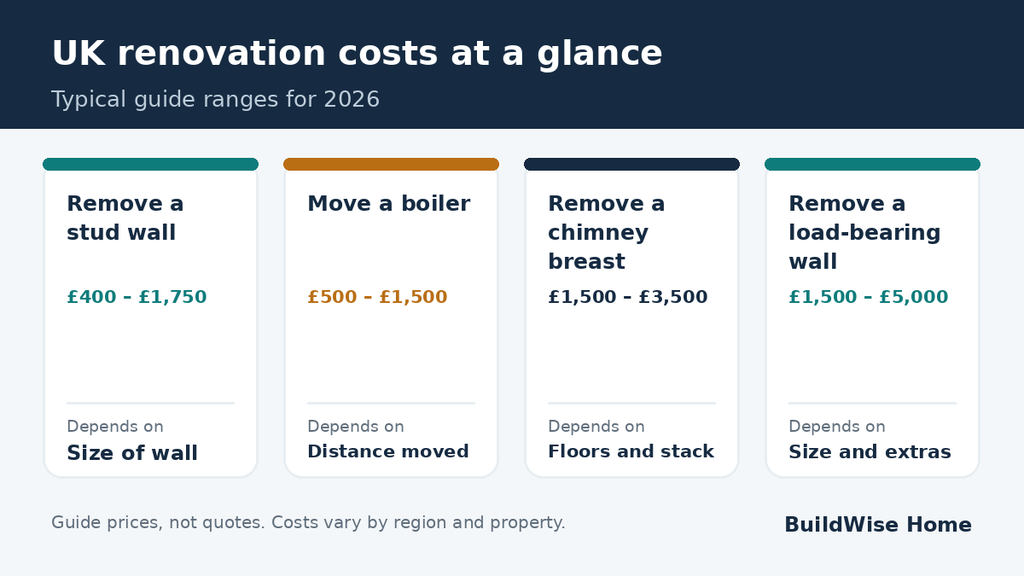
UK renovation costs and rules at a glance
| Job | Typical cost | Full guide |
|---|---|---|
| Remove a load-bearing wall | About £1,500 to £5,000 all in. A doorway-sized opening starts at about £1,100 | Cost to remove a load-bearing wall |
| Knock through a kitchen and dining room | About £2,000 to £5,000 with a steel beam | Knock through kitchen and dining room cost |
| Remove a stud wall | About £400 to £1,000 for a small wall, up to about £1,750 for a large partition | Cost to remove a stud wall |
| Structural engineer for a wall | About £200 to £500 for a visit or short report, and £300 to £900 for calculations | Structural engineer cost to remove a wall |
| Remove a chimney breast | About £1,500 to £3,500, depending on floors and the stack | Cost to remove a chimney breast |
| Move a boiler | About £500 to £1,500, depending on distance | Cost to move a boiler |
| Move a kitchen sink | About £150 to £3,500 or more, depending on how far it moves | Cost to move a kitchen sink |
| Toilet in a garden room | Water supply about £800 to £2,000 and a macerator about £600 to £1,200, plus the drain run and electrics | Toilet in a garden room |
Do you need approval? Quick answers
| Question | Short answer | Full guide |
|---|---|---|
| Knocking down a wall | Building regulations: yes for load-bearing walls. Planning permission: usually not for internal work | Building regulations to knock down a wall |
| Party wall agreement | Only if the work affects a wall or structure shared with a neighbour | Party wall agreement to knock down a wall |
| Removing a chimney breast | Building regulations normally needed. Planning permission usually not | Remove a chimney breast without building regulations |
| Moving a boiler | Gas Safe engineer required, and building regulations apply. Planning permission usually not | Building regulations to move a boiler |
| Replacing a kitchen | Like for like usually needs no approval. Changes to layout, drainage, electrics or gas may | Building regulations to replace a kitchen |
| Replacing a bathroom | Like for like usually needs no approval. A new bathroom, drainage or electrics may | Building regulations to replace a bathroom |
| Garden room with a toilet | Advice varies. Ask building control about the drainage | Building regulations for a garden room with a toilet |
| Knocking through to a conservatory | Usually yes, because the exemption is lost | Building regulations to knock through to a conservatory |
| A porch | Usually exempt if at ground level, under 30 square metres and the front door stays | Building regulations for a porch |
Why prices differ so much
The same job can be quoted at very different prices. The main reasons are:
- the size of the opening or the distance things move
- whether the quote is for labour only or an all-in price with the engineer, materials, approvals and finishing
- your region, with London and the South East usually the most expensive
- hidden work, such as wiring, pipes or old flues found once a wall is opened
- finishing, such as plastering, decorating and flooring, which is often left out of early quotes
Before you hire anyone
- Get at least three itemised written quotes, and ask what each one includes.
- Ask which approvals are needed, and who applies for them.
- Use registered professionals for gas and electrical work, and keep their certificates.
- Check that tradespeople have public liability insurance.
- Keep all your paperwork together for when you sell.
Official guidance
For official guidance, see the Planning Portal, your local council’s building control team, and the Gas Safe Register for checking gas engineers. Rules can differ between local authorities, so always confirm with your own council before starting work.
How we keep this page up to date
We re-check the figures in our guides against published UK sources, and update this page when they change. Last reviewed: 21 November 2026. This page is general information, not professional advice. Please read our Disclaimer.