Do You Need Building Regulations to Move a Boiler or Radiator? (UK Guide)
You need building regulations to move a boiler, and the work must be done by a Gas Safe registered engineer. The engineer normally handles the paperwork for you. Moving a radiator is less clear-cut. This guide covers England and Wales.
Do you need planning permission?
Usually no. Moving a boiler inside your home doesn’t normally need planning permission. If your home is listed, or the new flue will come out through an outside wall in a conservation area, check with your council first.
Building regulations to move a boiler
Boiler work is covered by building regulations because of the safety and energy efficiency rules that apply to heating and combustion appliances. Moving a boiler counts as boiler work, even if you’re keeping the same one.
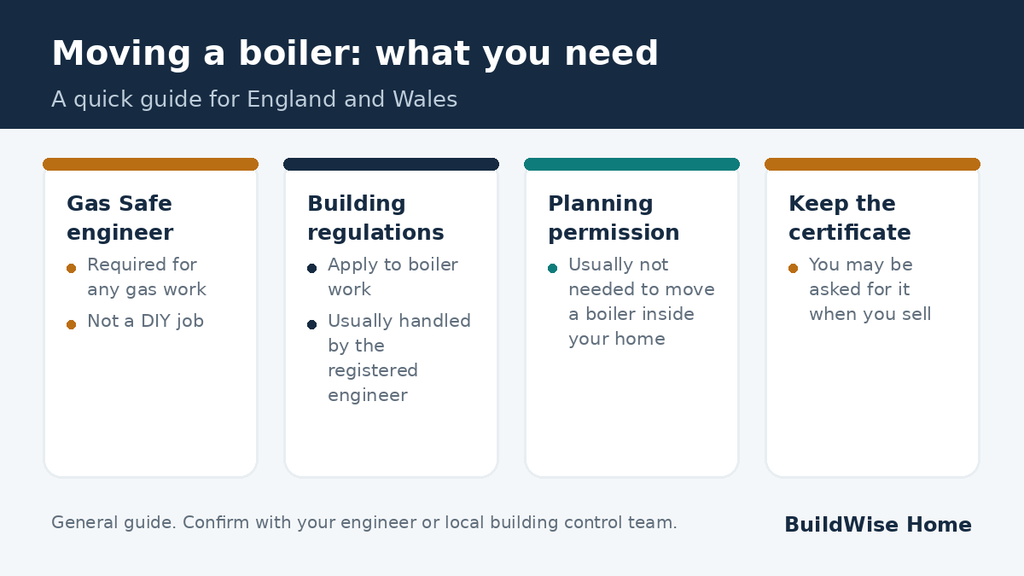
In practice, you rarely deal with building control yourself. A registered installer can notify the work through an official scheme, and building control does not need to be involved separately. Once the job is complete, you should receive:
- a Gas Safe certificate confirming the gas work is safe
- a building regulations compliance certificate, issued through the installer’s scheme
Keep both somewhere safe. A missing certificate can slow down a house sale.
Who can move a boiler?
Moving or installing a gas boiler is not a DIY job. Any gas work must be done by an engineer on the Gas Safe Register. Ask to see their Gas Safe ID card before they start, and check that the card lists the type of work you need.
Where can a boiler go?
A boiler can’t go just anywhere. Your engineer has to follow gas and building rules that decide where the appliance and its flue can be placed. Things they will check include:
- enough airflow around the boiler
- easy access for servicing and repairs
- a safe route for the flue to the outside
- a drain for the condensate, if you have a condensing boiler
- extra rules for lofts, such as safe access and lighting
If there’s no suitable drain near the new location, one may need to be installed, which can make the job bigger and more complicated. For price ranges, see our guide to the cost to move a boiler.
What about moving a radiator?
Radiators are different, because they don’t involve gas. Plumbers on advice sites generally say that replacing a radiator like-for-like doesn’t need building control involvement. Moving a radiator to a new position, or adding one, is described as a grey area.
For radiators on their own:
- You don’t need a Gas Safe engineer for the radiator itself, because no gas is involved.
- Use a competent plumber, particularly if the move changes your heating pipework.
- If you’re unsure, ask your local building control team before starting.
If you’re moving the boiler at the same time, the boiler rules above apply to the whole job.
Other projects with similar rules
Heating and plumbing changes can bring other projects under approval too. See our guide to the building regulations for a garden room with a toilet, and our guide to the building regulations to knock down a wall.
What happens if you skip the paperwork?
Work done by someone who isn’t registered can be dangerous, and you won’t get the certificates a buyer’s solicitor may ask for. It can also affect your home insurance.
Scotland and Northern Ireland
Scotland and Northern Ireland have different systems, so don’t rely on this guide there. Contact your local council.
Frequently asked questions
Do I need planning permission to move a boiler?
Usually no, if the work is inside your home. Check first if your home is listed or in a conservation area.
Can I move a boiler myself?
No. Gas work must be done by a Gas Safe registered engineer.
Do I need building control involved?
Normally the registered engineer deals with this through their scheme, and you receive a certificate when the work is done.
Do I need a Gas Safe engineer to move a radiator?
Not for the radiator itself, because it doesn’t use gas. Moving a boiler or any gas pipework does need one.
Sources
This guide is based on information from the Planning Portal, EDF and Book a Builder UK, reviewed in October 2026. It is general information, not professional advice. Last updated: 1 November 2026.
3 Comments
Comments are closed.