Do You Need a Party Wall Agreement to Knock Down a Wall? (UK Guide)
You only need a party wall agreement to knock down a wall if the work affects a wall or structure you share with a neighbour. An ordinary internal wall inside your own home doesn’t need one. This guide covers England and Wales.
What is a party wall?
A party wall is a wall shared by two properties, such as the wall between two semi-detached or terraced houses. The Party Wall etc. Act 1996 sets out what you must do before building work that affects it.
When you need a party wall agreement to knock down a wall
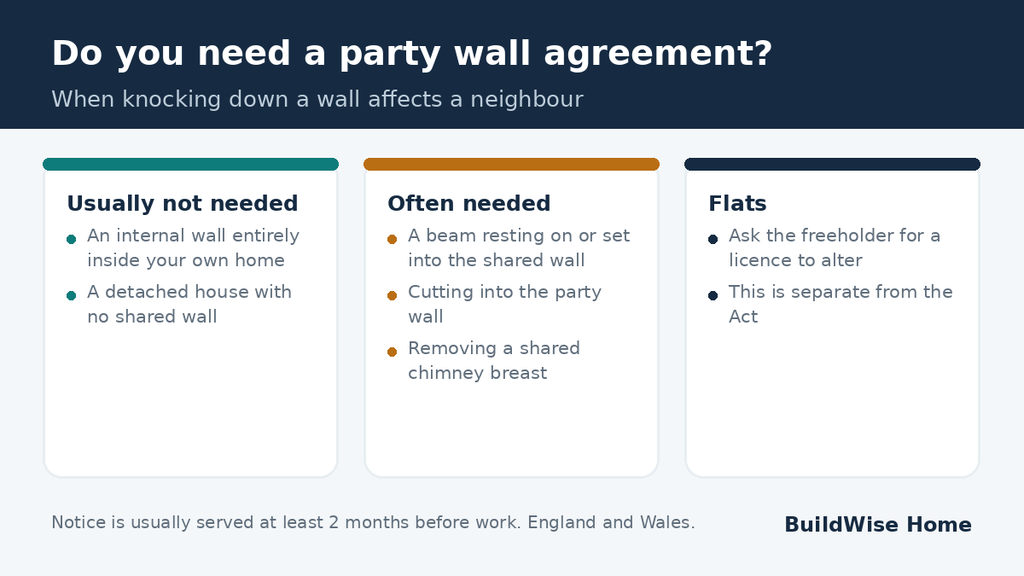
Internal walls inside your own home
Removing a wall that sits entirely within your home normally doesn’t involve your neighbour, so you don’t need a party wall agreement. You may still need building regulations approval, which is a separate matter.
Walls that touch the party wall
You are more likely to need an agreement if the work affects the shared wall. Common examples:
- a steel beam that rests on or is set into the party wall
- cutting into the party wall to make an opening or fit support
- removing a chimney breast that forms part of the shared wall
If you are unsure, ask a structural engineer or a party wall surveyor to look at where the beam bears and whether the work affects the shared structure.
Flats and leasehold homes
The Act mostly deals with neighbouring houses. In a flat, you usually need written permission from the freeholder, often called a licence to alter, and your lease may set extra rules. This is separate from the Act, and a neighbour in the flat above or below may still raise concerns.
What a party wall notice involves
If the Act applies to your work, you serve written notice on your neighbour at least two months before the work starts. Your neighbour can then:
- Agree in writing, and the work can go ahead.
- Disagree, which means surveyors are appointed to settle an agreement, called an award.
A neighbour can’t simply block your work, but a dispute can cause delay. The person carrying out the work usually pays the reasonable surveyor costs. You can write a simple notice yourself using a standard template, but for anything involving structural work it is often worth getting advice.
What happens if you skip it?
Starting work without the required notice can lead to disputes, delays and claims for any damage to your neighbour’s property. It can also cause problems when you sell.
A party wall agreement is not the same as building regulations or planning
These are three separate things:
- Party wall agreement: protects your neighbour’s property.
- Building regulations: cover safety and structure. See our guide to the building regulations to knock down a wall.
- Planning permission: usually not needed for internal work, unless your home is listed.
Planning your budget? Our guide to the knock through kitchen and dining room cost explains what the work typically costs.
Scotland and Northern Ireland
The Party Wall etc. Act 1996 applies in England and Wales. Scotland and Northern Ireland have different systems, so don’t rely on this guide there.
Frequently asked questions
Do I need a party wall agreement to remove an internal wall in a detached house?
Usually not, because there’s no wall shared with a neighbour.
Do I need one to remove a chimney breast?
Often yes, if the chimney breast is part of a shared wall.
Can my neighbour stop me?
They can disagree, which leads to surveyors settling an agreement, but they can’t simply veto reasonable work.
Do I need a party wall agreement to knock down a wall?
Only if the work affects a wall or structure you share with a neighbour. An internal wall within your own home doesn’t need one.
Do I need a surveyor?
Only if your neighbour doesn’t agree, or if you want expert advice on whether the Act applies.
Sources
This guide is based on advice from Homebuilding & Renovating and the Planning Portal, reviewed in October 2026. It is general information, not legal advice. Last updated: 30 October 2026.
4 Comments
Comments are closed.